What Advertisers Know About You (And How to Use It on Yourself)
A while back I got curious about why I can still recite a jingle for a cereal I haven't eaten since I was nine, but I couldn't tell you what I had for lunch on Tuesday.
That bugged me for longer than it probably should have. Somewhere out there, an ad executive who retired before I graduated high school is still living rent-free in my skull, and he did it with about thirty seconds of catchy nonsense and a cartoon mascot.
Meanwhile, I've spent years trying to convince myself that I'm capable, that I've got this, that today is going to be a good day — and half the time that message doesn't even survive breakfast.
So I started asking a different question. Not "why do ads work on me," but "how do ads work on me," and could I steal the playbook?
Turns out… yes I can.
The Advertisers Already Figured This Out
Here's the thing about a good ad campaign — it's not really selling you a product. It's building an association. Feel this feeling, see this image, hear this music, and somewhere in the mix, a brand name gets stapled to it. Do that enough times and the brand starts borrowing the feeling. That's it. That's the whole trick.
Companies pour absurd amounts of money into figuring out what makes us tick and exactly which buttons to push, and they push them relentlessly, from every direction, until we've bought the sneakers or the soda or whatever it is without ever consciously deciding to.
And look, I'm not saying that's the most noble use of psychology. But I am saying it works, and I got tired of being on the receiving end of it without ever putting it to use for myself.
Here's the part that surprised me most. Emotional messaging beats rational messaging almost every time, and not by a little. You'd think facts and figures would win the day — better ingredients, better price, better specs. But feelings bypass all of that number-crunching entirely and go straight for memory, connection, and preference. We feel first and think second, and by the time the thinking part shows up, the feeling part has usually already made up its mind.
That's why the ads that stick with us for decades are almost never the ones reciting features. They're the ones that hit us with nostalgia, or made us laugh, or wrapped us in some warmth we didn't know we needed that day. Warmth and trust get decided in our gut long before we've consciously judged whether a brand knows what it's doing. Nostalgia, humor, warmth, a shot of inspiration — different flavors of the same trick. Make someone feel something, and the loyalty tends to follow.
There's another piece to this too, called the mere-exposure effect — a fancy way of saying our brains tend to warm up to things simply because we've seen them a bunch of times. Familiarity gets mistaken for trust. That's why a brand doesn't need to convince you of anything up front — it just needs to keep showing up until showing up becomes its own kind of argument.
Stack that repetition on top of an emotional hook, and you've basically bypassed the part of the brain that likes to weigh pros and cons. You're not being persuaded so much as you're being imprinted on.
None of that is some dark secret, by the way. It's just how memory and emotion work together, and the ad world has been putting it to very good use for a very long time. So the question I landed on wasn't how to build up more resistance to it. It was, why am I letting other people be the only ones who get to use it on me?
And to be clear, these are just two tricks in a much bigger toolbox. There's a lot more going on behind the scenes than I could possibly get into in one sitting, and honestly, that's not really the point of this piece anyway. The thing worth remembering is that the good campaigns rarely lean on just one trick at a time. They layer them, one on top of the other, until you're not reacting to a single nudge but a whole pile of them working together. Each one on its own is persuasive. Stacked up, they're close to unstoppable.
So I Started Running My Own Campaign
I call it Targeted Message Delivery, which sounds a lot fancier than what it actually is. It's me, deciding what I want to believe about myself, and then bombarding myself with it the same shameless way a soda company bombards me with fizzy happiness.
A few things I figured out along the way:
The message has to be mine. Not some borrowed line from an inspirational poster hanging in my dentist's waiting room. Something that hits close to home. Something relevant and specific to my life.
It has to show up everywhere. One good pep talk in the mirror isn't going to undo years of negative self-talk. But a message on my lock screen, and my computer wallpaper, and repeated out loud in the car, and worked into my journal — that starts to add up. I did some rough math once on how many times a work computer wallpaper gets seen in a year. It's a lot. If a company put an ad in front of me that many times, I'd have bought whatever they were selling long before I hit that number.
It works better with a little emotional glue. Advertisers pair their pitch with music, with a story, with something that makes you feel a certain way, because feelings stick harder than facts. So I do the same. Crank a song I love, say the thing out loud, get my body moving while I say it. It sounds a little silly. I'm okay with that.
This Isn't About Pretending
I want to be upfront about something, because I don't want this to come across as some magic trick where you say nice things to yourself ten times and your problems evaporate. They don't. I still have bad days. I still catch myself spiraling into old patterns.
The difference is I've got something competing for the airtime now. Instead of the only message on repeat being the doubt, there's an actual challenger in the ring — one I built, on purpose, for a reason.
And here's the part that still gets me a little: none of this requires a marketing degree or a budget. Just repetition, a little creativity, and the willingness to treat your own mindset like something worth investing in.
So if that cereal jingle can live in my head rent-free for four decades, I figure I can make room for a message or two of my own.
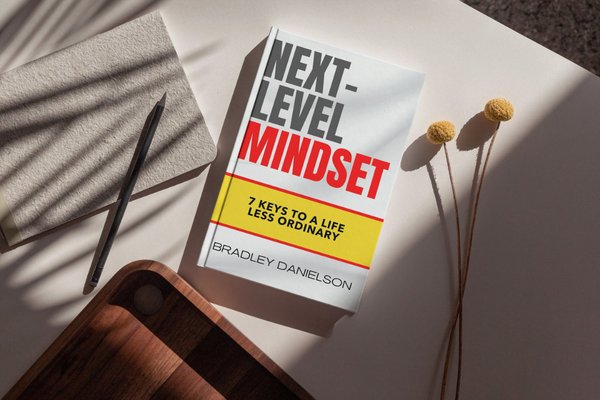
It's one of the ideas I dig into in my book Next-Level Mindset: 7 Keys to a Life Less Ordinary — link here if you're curious.