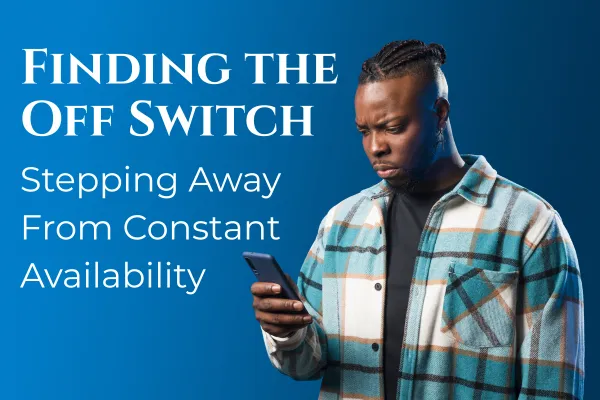
Finding the Off Switch - Stepping Away From Constant Availability
Let me tell you about the most stressful eleven seconds of my week.
It's 7:47 on a Saturday night. I'm on the couch, watching the hockey game. The dog is doing that thing where he sits in front of me and stares at me until I finally give in and agree to sit on the floor with him while he does important things like chewing on stuff. He’s not allowed on the furniture (most of the time). And for approximately four minutes, I have been what you might generously call relaxed. And then my phone lights up.
Now here's the thing — it's probably nothing. A newsletter I forgot I subscribed to. An app update. My mobile phone provider offering me a 10 percent discount on hotels for the next vacation I’m not going to take. But I won't know that until I check. And I can't not check, because what if it's not nothing? What if it’s my boss? What if I miss something important?
So I check. It's a promotional email from a company I’ve never heard of and aren’t even sure exists.
Eleven seconds of low-grade panic. For a spammy email.
This is what it means to be ‘always on’. But we don’t need to be available to everyone all the time.
It Didn't Used to Be Like This (Back in My Day…)
I know that sounds like the opening line of a grumpy-old-man speech, so bear with me. I'm not about to tell you the internet ruined everything and we should all move to a cabin and live off the grid. That ship has sailed, and frankly, I need GPS.
But here's what's true: there used to be a moment — a physical, tangible moment — when work ended. We left the office. We got in the car. We walked through the front door. And that was the signal. The day is done. The problems, whatever they are, will still be there tomorrow. Right now, there is dinner, maybe the third period of the hockey game, and the sweet, uncomplicated business of just being a person.
That signal doesn't exist anymore.
The office followed us home in a rectangle we carry in our pockets. And somewhere along the way — slowly, silently, without anyone really signing off on it — we agreed to be available. All the time. For everything. Just in case.
We didn't decide that, exactly. It just... happened. Quietly. Over time.
The Thing Nobody Talks About
Here's what I've noticed in the conversations I’ve been having with friends, co-workers, clients, and my podcast listeners — our inability to fully turn off has more to do with a steady drip of tension than any specific crisis we may be dealing with.
It's more like... static. A low-level, background disturbance that never seems to go away. A constant trickle of pressure. The mental tab that's always open. The nagging awareness that the phone is there, that someone could need something, and that we should probably check our email just one more time before bed.
We don't need to be available to everyone all the time.
Chronic low-grade stress, the researchers call it. I call it static. And the sneaky thing about it is that we stop noticing it after a while — until we go somewhere without reception for a weekend and suddenly realize we’ve been grinding your teeth for six months.
Sound familiar? Yeah. I thought so.
Why We Don't Just... Stop
Here's the question I always get, Brad, if it's so bad, why don't people just put the phone down?
Fair. Let's play a game.
Hands up if you've ever checked your email at 10 PM, told yourself it was just to make sure nothing's on fire, and then spent the next 30 minutes composing a response to something that absolutely could have waited until morning.
I see those hands. Mine is up too.
The thing is, it’s not always that easy to “just put in down.” We’ve built tools that are specifically designed to be hard to put down — and then put them in charge of our professional reputations.
Of course we can't stop checking. We've been trained to respond. We've been rewarded for being fast. And now being available has become such a deeply baked-in signal of I'm a good employee, a reliable person, a serious professional that opting out of it feels like a risk.
What It's Actually Costing You
I'm going to skip the part where I cite a bunch of statistics about productivity and burnout. You know it's bad. You can feel it's bad. You don't need a pie chart.
What I want to talk about instead is the stuff you might not have named yet.
The moments of actual rest that make you feel vaguely guilty — like you're getting away with something. The conversations where your body is present but your attention is somewhere in the middle distance, half-listening for a ping. The hobbies that quietly fell away because they required a kind of sustained focus that's gotten harder to access. That part of you that used to do things in your “spare time” for no other reason than you enjoyed doing them.
This constant gravitational pull towards your devices doesn't just wear you down over time. It crowds out the good stuff. The creative stuff. The stuff that makes you feel like a full human being rather than a very efficient meat-based notification system. And most of us can feel this on some level.
So What Do We Do?
I’m not going to give you a five-step plan to digital detox your way to enlightenment. Mostly because I don’t think that’s actually the answer. And also—good luck getting through your day without your phone. That’s just where we’re at now. We rely on the technology we’ve created.
So this doesn’t start with removing it. It starts with changing how you relate to it. Smaller than that. It starts with finding the signal again.
Not a rigid schedule. Not a manifesto about work-life balance that you stick to the fridge and ignore within a week. Just a signal.
A simple, intentional moment where you put it down—on purpose. Not because there’s nothing to check, but because you’ve decided this part of the day is going to belong to you and only you. Maybe that means leaving it in another room for 15 or 20 minutes. Maybe it’s just flipping it over and not reaching for it.
For some people it's a walk. For some it's cooking an actual meal instead of Door Dash or Skip. For some, it's a 10-minute sit-down before bed that has nothing to do with productivity. The content almost doesn't matter.
What matters is that you do it consistently enough that your brain starts to recognize it as a shift.
Not a pause. Not a break.
A clear signal that says “I’m done here… for now.”
If this hit somewhere close to home, sit with it for a minute. Not to analyze it — just to recognize it. That awareness is where things start to shift.
And if you’re ready to interrupt this cycle, I’ve put together a short guided meditation right here called Finding the Off Switch. It’s 10 minutes, and it’s designed for exactly this.
Try it tonight. No multitasking. No checking your phone halfway through. Just 10 minutes off.
Prefer audio-only? You can also listen on the Workforce Nation podcast.