
Why We Struggle To Disconnect From Work
There’s a particular kind of exhaustion that doesn’t always come from working long hours. It comes from never quite leaving work behind.
You close your laptop.
You drive home.
You sit down at the dinner table.
And yet… you’re still in the meeting. Replaying something you said. Rewriting an email in your head. Anticipating tomorrow before today has even had a chance to end.
From the outside, everything looks balanced. You showed up. You logged off. You’re home.
From the inside? Your mind is still on the clock.
For a long time, I told myself this was just part of being ambitious. Part of caring. Part of wanting to do good work. But eventually, I had to ask a harder question—at what point does caring become carrying?
The Power of Our Presence
I vividly remember going to a movie with a friend one night. It was supposed to be a simple, low-key evening. Popcorn. Two hours of entertainment. Zero responsibility.
Perfect.
Except… I brought the office with me.
The previews were playing and I was already replaying a conversation from earlier that day. By the time the main character hit their first dramatic turning point, I was mentally drafting tomorrow’s to-do list.
At one point my friend leaned over and whispered, “This part is wild.”
I nodded like I was fully engaged. I was not fully engaged. I was running an internal performance review of myself.
By the end of the movie, I couldn’t have explained the plot if my life depended on it. I had spent two hours physically in a theater and mentally in a conference room.
Of course, I justified it.
“I’m driven.”
“I care.”
“This is what high standards look like.”
But if I’m honest, it didn’t feel like high standards. It felt like I didn’t know how to turn it off. And over time, that non-stop thinking started taking a toll.
On my presence.
My patience.
My joy.
It wasn’t that I needed to be less ambitious. I needed a way to consciously shift out of work mode and stop allowing it to consume my entire life.
The Hidden Attachment Most of Us Don’t See
Eventually, I realized it wasn’t always work demands keeping my brain working overtime, it was attachment to performance.
When your identity is tied to doing well…
When your standards are high…
When you take pride in being reliable and capable…
Your mind doesn’t clock out just because the office does. It stays alert. Reviewing… optimizing… planning your next move. Not because you need to. Because you care.
But that’s where it gets tricky. The very trait that helps you succeed—conscientiousness—can quietly become the thing that prevents you from resting.
We’re taught how to push. How to grind. How to chase the next milestone. Rarely are we taught how to step back without feeling like we’re falling behind.
Why “Work-Life Balance” Never Worked for Me
For years, I tried to adopt the idea of work-life balance. Set boundaries. Leave work at work. Draw a clean line between the two. In theory, it sounded responsible, mature, and well-adjusted. In practice, it felt forced.
For people who genuinely care about their work, it’s not just a paycheck. It’s contribution. It’s growth. It’s an expression of who we choose to be. We are not our jobs. But how we do our jobs reflects something about us.
Trying to draw a hard line in the sand often created more tension, not less. I’d feel guilty when I was working and restless when I wasn’t.
That’s when I started reconsidering the goal itself. Maybe it isn’t balance. Maybe it’s harmony.
From Balance to Harmony
Instead of trying to separate work and life, I focused on finding ways to transition between them. Nothing dramatic. No long rituals or routines. Just simple, structured resets—moments where I deliberately told my mind, “Hey, it’s okay to take a break.”
At first, it felt a little uncomfortable. My brain wanted to keep solving. It kept trying to sneak back into planning mode.
But over time, something shifted. The mental noise quieted faster. The tension didn’t linger as long. I could feel the difference between being physically home and being mentally and emotionally home.
I was still ambitious. I still cared. I just wasn’t carrying work into every corner of my life.
The Power of a Structured Reset
What I’ve come to believe is this:
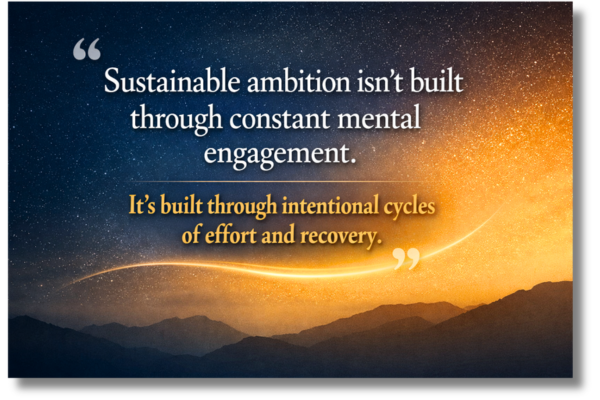
High performers don’t need less drive. They need structured recovery. We schedule meetings, workouts, projects, goals, and many other things. But we rarely schedule decompression. So the mind stays in performance mode indefinitely.
A reset doesn’t mean you care less. It means you respect your cognitive limits. It’s not about escaping work. It’s about preparing to return to it steadier and more focused.
That’s why I began building short, intentional mental reset practices into the end of my workday.
What Changed
When I started practicing deliberate transitions, a few subtle but powerful shifts happened.
I was more present at home. I wasn’t half-listening during conversations. I slept better. I woke up clearer.
And interestingly—my work improved. Because I wasn’t dragging yesterday’s mental clutter into the next day, I didn’t lose my edge. If anything, I sharpened it.
If This Feels Familiar
If you’ve ever felt physically home but mentally still at the office, you’re not alone. You probably care. A lot.
But professional ambition without any means of recovery becomes unsustainable, wears us down, and can lead to burnout.
You don’t need to stop caring about your work. You just need intentional moments where your mind is allowed to step out of work mode and focus on other aspects of your life. That’s what harmony looks like.
So, if your body has left work but your mind hasn’t, don’t just reflect on it— practice the transition.
Below, you’ll find a 10-minute guided Work-Life Reset created specifically for this moment. This reset is where that recovery begins. Give yourself ten minutes. Then notice the difference.
Experience the reset on YouTube
If this reset resonates with you, I share a episode every Tuesday on YouTube at Workforce Nation: Meditation for Work-Life Harmony. You’re welcome to join us there.
Prefer audio-only? You can also listen on the Workforce Nation podcast below: